





 +86 15913754357
 sales@xirotech.cn

 Release time:2026.01.16
Cracking, delamination, and edge chipping in powder metallurgy (PM) green compacts are among the most critical forming defects in industrial production. These defects directly compromise mechanical strength, dimensional accuracy, and overall production yield, while significantly increasing scrap rates during sintering and secondary machining processes.
From an engineering perspective, green compact cracking is not caused by a single parameter deviation. Instead, it is the result of a complex coupling between powder material behavior, die design, frictional conditions, process parameters, and—most importantly—the dynamic characteristics of the powder press itself.
This article analyzes the root causes of cracking in powder metallurgy compaction from the perspectives of powder mechanics, die dynamics, and process control theory. It further compares hydraulic powder presses and mechanical powder compacting press in terms of their inherent ability to suppress cracking defects. Special emphasis is placed on how high-rigidity mechanical powder compacting press, through deterministic kinematics and exceptional bottom dead center (BDC) repeatability, provide decisive advantages in density control, stress distribution, and stable ejection—offering practical guidance for PM process optimization and equipment selection.
1. Failure Mechanisms of Green Compact Cracking
Stress Mismatch Under Multi-Physics Coupling
The fundamental cause of green compact cracking is that internal stresses exceed the mechanical strength of the compacted powder body. This process involves the interaction of multiple physical phenomena, including powder rearrangement, particle plastic deformation, frictional resistance, and gas compression and release.
Powder characteristics—such as particle morphology, size distribution, hardness, plasticity, and lubricant content—play a decisive role in green strength and stress evolution. These material factors must therefore be treated as baseline conditions when analyzing cracking mechanisms. In practice, the primary causes of cracking can be summarized into the following five categories.
1.1 Stress Concentration Caused by Non-Uniform Powder Filling
Improper adjustment of automatic powder feeding systems or poor die cavity surface conditions often result in non-uniform powder filling. During compaction, powder flows from regions of higher fill density toward lower-density regions, generating complex internal shear stresses.
At density transition zones, these shear stresses can easily exceed the shear strength of the green compact, leading to internal micro-cracks or lamination that may not be immediately visible after pressing.
1.2 Restricted Gas Permeation in the Die Cavity Leading to Delamination
Powder beds behave as porous media. During high-speed compaction, air trapped between powder particles is rapidly compressed. If die venting design—such as vent location, quantity, or diameter—is insufficient, or if compaction speed is excessively high, compressed gas cannot escape in time.
Residual gas pressure, combined with density gradients and elastic recovery during punch withdrawal or ejection, may cause internal layer separation or blistering, commonly observed in thick-wall sections or blind-hole bottoms. In medium-sized components typically produced on 60-ton mechanical powder compacting press, optimizing the compaction speed profile is essential to balance productivity and gas evacuation. In critical cases, vacuum-assisted venting systems can further mitigate this risk, and a stable press motion profile provides a reliable foundation for such solutions.
1.3 Residual Stress Induced by Density Gradient and Elastic Springback
Due to friction between powder and die walls—generally described by Coulomb friction behavior—compaction pressure exhibits a pronounced non-linear attenuation along the height of the compact, resulting in unavoidable density gradients.
After ejection, regions with different densities recover elastically to different extents. Higher-density zones exhibit greater elastic recovery, while lower-density zones recover less, generating residual tensile stresses within the compact. When these stresses exceed the transverse or interlayer strength of the green compact, circumferential cracks or delamination occur.
Green strength is closely related to powder plasticity, lubricant effectiveness, and particle shape. Optimizing these factors improves crack resistance. For components with moderate height-to-diameter ratios, the stable compaction end position provided by a 40-ton mechanical powder press forms the basis for consistent residual stress control.
1.4 Die System Dynamic Response and Local Stress Concentration
Misalignment:
In multi-punch or complex tooling systems, poor punch synchronization or alignment accuracy introduces non-axial forces, resulting in asymmetric density distributions and shear cracking. This is particularly critical for large or complex parts formed on 200-ton mechanical powder compacting press, where precise motion coordination is essential.
Design Defects:
Sharp corner radii or abrupt geometric transitions obstruct powder flow, causing localized stress amplification far beyond average levels and creating crack initiation sites.
Wear and Scoring:
Worn die walls increase friction and aggravate density gradients, while surface scratches act as stress concentrators that may propagate into visible cracks during ejection.
1.5 Dynamic Load Impact During Ejection
Ejection is one of the most mechanically demanding stages for a green compact. Rapid force buildup or unstable ejection velocity transforms static friction into dynamic stick-slip behavior, generating impact loads.
For parts with large height-to-diameter ratios or complex geometries, such non-smooth ejection easily triggers longitudinal cracking or edge chipping at weak cross-sections. Even for small precision components produced on 20-ton mechanical powder compacting press, ejection smoothness remains a decisive factor in preventing brittle failure.
2. Crack Suppression Capability: Hydraulic vs. Mechanical Powder Presses
A powder press is not merely a force generator; it is the executor of process dynamics. Its structural characteristics directly determine the precision and stability of compaction and ejection behavior.
2.1 Hydraulic Powder Presses: Flexibility with Inherent Uncertainty
Hydraulic powder presses offer stepless adjustment of force and stroke and high programming flexibility, making them suitable for R&D, small-batch production, ultra-high tonnage applications, or processes requiring complex multi-stage pressure profiles. Modern servo-hydraulic systems have significantly improved response speed and controllability.
However, in crack control, several inherent limitations remain:
System Lag and Bandwidth Limits:
The bulk modulus of hydraulic oil—affected by temperature and entrained air—defines system stiffness and dynamic response. Valve flow characteristics and internal leakage introduce phase lag and amplitude attenuation, especially during holding and direction reversal, effectively injecting uncontrollable disturbances into the process.
Parameter Drift and Long-Term Stability:
Long-term performance depends heavily on oil cleanliness, temperature stability, and sealing integrity. Progressive wear alters the system transfer function, gradually narrowing the effective process window and increasing crack risk.
Non-Rigid Force Transmission Path:
Multiple compliant elements (oil, hoses, seals) prevent the establishment of an absolute geometric stop. The bottom dead center is essentially a force equilibrium point rather than a fixed mechanical position.
Hydraulic and mechanical presses each have their optimal application domains. This article focuses on high-volume manufacturing environments that demand extreme consistency, high production rates, and long-term stability—conditions under which mechanical presses exhibit intrinsic advantages.
2.2 Mechanical Powder Presses: Rigidity and Deterministic Consistency
Mechanical powder compacting press form a deterministic motion chain using high-rigidity structures such as frames, crankshafts, connecting rods, and bearings. Slide motion—displacement s(t), velocity v(t), and acceleration a(t)—is uniquely defined by geometry, ensuring natural repeatability.
Key inherent advantages in crack suppression include:
Optimized Natural Kinematics:
In toggle or near-toggle mechanisms, slide velocity naturally decelerates near BDC, creating a physically enforced relaxation window for powder rearrangement, plastic flow, and gas diffusion—reducing strain-rate-sensitive cracking tendencies.
Geometrically Defined Bottom Dead Center:
BDC is determined by the mechanical dead point of the crank or toggle system. Structural deformation under load is minimal and highly repeatable, providing a stable physical reference for compaction displacement and compression ratio consistency.
Decoupled Ejection Drive Systems:
Advanced mechanical powder compacting press employ independently driven ejection mechanisms, with motion profiles precisely defined by cams or screw drives. This ensures smooth, repeatable ejection and eliminates the “creep” commonly associated with hydraulic systems. Such configurations are now standard in mechanical powder compacting press rated at 60 tons and above.
3. Core Process Control Advantage of XIRO Mechanical Powder Presses
Bottom Dead Center Repeatability
Bottom dead center repeatability is one of the most critical precision indicators of a mechanical powder press, typically controlled within ±0.01 mm to ±0.03 mm. This parameter has a decisive impact on crack suppression.
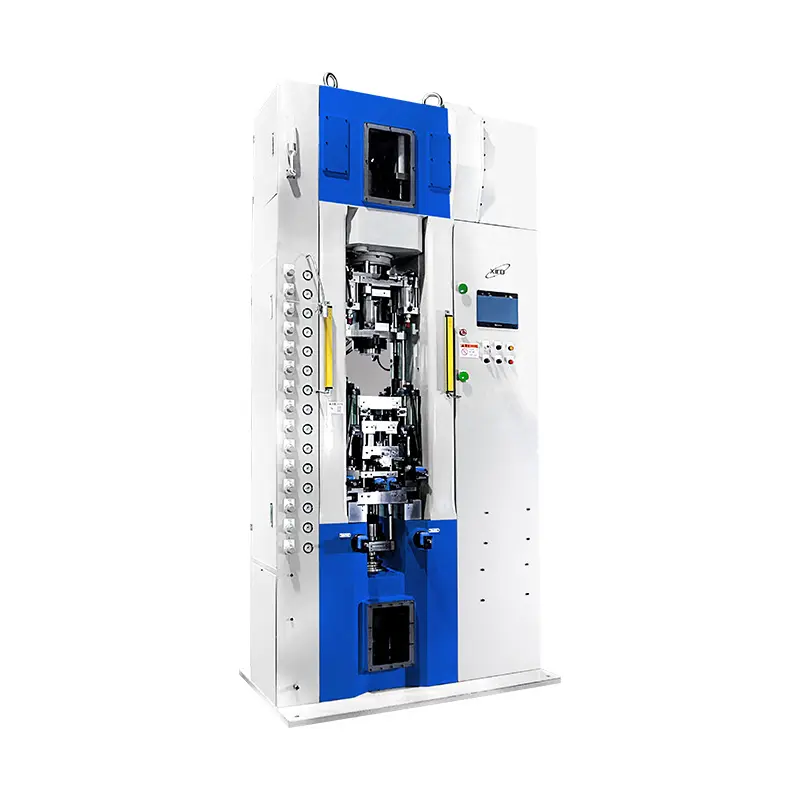
XIRO Mechanical Powder Compacting Press (Customizable)
3.1 Direct Stabilization of the Density Field
Within a given powder system, final density can be regarded as a single-valued function of compaction displacement. When BDC variation is constrained to the micrometer level, density fluctuations—and the residual stress fields they generate—are effectively stabilized, eliminating a major source of crack variability.
3.2 Solidification and Expansion of the Process Window
Cracking indicates that the operating point has crossed the failure envelope. High repeatability compresses process spread, allowing engineers to operate with greater safety margins and effectively broadening the usable process window while improving robustness.
3.3 Superior Long-Term Process Capability (Cpk)
Mechanical system accuracy degrades slowly and predictably due to wear physics. With proper maintenance, production lines based on XIRO mechanical powder compacting press can maintain excellent long-term Cpk values, meeting stringent DPPM requirements in automotive and aerospace applications. For example, production cells composed of multiple 80-ton mechanical powder compacting press for connecting rods or sprockets rely on this stability to sustain high OEE.
Conclusion
Green compact cracking in powder metallurgy is a systemic issue involving material properties, tooling design, process parameters, and equipment dynamics. For manufacturers pursuing high quality, high efficiency, and long-term production stability, selecting a precision mechanical powder press with excellent bottom dead center consistency and smooth ejection dynamics is a strategic decision rather than a mere equipment upgrade.
By transforming compaction and ejection from fluctuation-prone control actions into predictable mechanical laws, XIRO mechanical powder compacting press establish a stable physical baseline that suppresses density variation, optimizes stress distribution, and eliminates dynamic impact during ejection. This stability provides a reliable platform upon which powder formulation, tooling design, and lubrication strategies can be optimized—making mechanical press precision one of the highest-leverage investments in achieving near-zero-defect powder metallurgy production.


